

[Oct-2023] C-HCMOD-05 Exam Dumps - Free Demo & 365 Day Updates
Free Sales Ending Soon - Use Real C-HCMOD-05 PDF Questions
NEW QUESTION # 12
Which project structure object corresponds to a unique HDI container?
- A. space
- B. src folder
- C. database module
- D. project
Answer: B
NEW QUESTION # 13
A new version of SAP HANA Cloud, SAP HANA database is available from today.If you do not perform the upgrade manually, how much time do you have before your database will be automatically upgraded to the next version?
- A. 1 year
- B. 3 months
- C. 2 weeks
- D. 7 months
Answer: D
NEW QUESTION # 14
Why would you use the Transparent Filter property in a calculation view?
- A. To apply filters that are hidden from the end user
- B. To avoid columns being unnecessarily used in an aggregation
- C. To allow filter push-down in stacked calculation views
- D. To include columns that are NOT requested by a query
Answer: B
NEW QUESTION # 15
Why might you use the Keep Flag property in an aggregation node?
- A. To ensure that the aggregation behavior defined in the aggregation node for a measure CANNOT be overridden by a query
- B. To include columns that are NOT requested by a query but are essential for the correct result
- C. To retain the correct aggregation behavior in stacked views
- D. To exclude columns that are NOT requested by a query to avoid incorrect results
Answer: B
NEW QUESTION # 16
Which of the following data sources can you include in a graphical calculation view?Note: There are 2 correct answers to this question.
- A. Procedure
- B. Table function
- C. Scalar function
- D. Row table
Answer: B,D
NEW QUESTION # 17
Which database features are typically NOT required by analytical applications that run on SAP HANA Cloud?Note: There are 2 correct answers to this question.
- A. Table partitions
- B. Stored procedures
- C. Pre-calculated aggregates
- D. Indexes
Answer: B,C
NEW QUESTION # 18
Which type of join supports a temporal condition in a calculation view?
- A. Referential join
- B. Left outer join
- C. Inner join
- D. Text join
Answer: C
NEW QUESTION # 19
Why would you set the "Ignore multiple outputs for filters" property in a calculation view?
- A. To hide columns that are not required
- B. To avoid duplicate rows in the output
- C. To ensure semantic correctness
- D. To force filters to apply at the lowest node
Answer: D
NEW QUESTION # 20
A calculation view includes a rank node that uses the source data and settings shown in the graphic.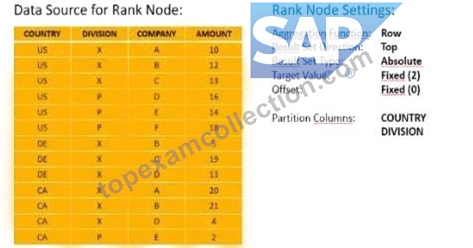
Your query requests all columns of the rank node.How many rows are in the output of your query?
- A. 0
- B. 1
- C. 2
- D. 3
Answer: B
NEW QUESTION # 21
Why would you choose an HDI-shared service plan instead of a schema service plan?Note: There are 3 correct answers to this question.
- A. You want to use containers to isolate objects.
- B. You want to use synonyms to access external data.
- C. You want to use SAP Business Application Studio.
- D. You want to develop calculation views.
- E. You want to create database objects using source files.
Answer: A,C,E
NEW QUESTION # 22
Which components are part of SAP HANA Cloud?Note: There are 2 correct answers to this question.
- A. Data lake
- B. SAP Analytics Cloud
- C. SAP Enterprise Architecture Designer
- D. SAP HANA database
Answer: A,D
NEW QUESTION # 23
You have imported calculation views from SAP HANA on-premise to SAP HANA Cloud.Why should you switch calculated column expression language from column engine to SQL?
- A. To define limits for query unfolding
- B. Column engine language is not supported.
- C. To benefit from additional SQL optimizations
- D. Incorrect aggregations may be generated
Answer: C
NEW QUESTION # 24
In a calculation view, what is the purpose of a variable?
- A. To break up complex SQL into smaller steps
- B. To provide a dynamic value in a calculated column
- C. To pass values between procedures and calculation views
- D. To filter an attribute at runtime based on a user input
Answer: D
NEW QUESTION # 25
Why would you create SQL in calculation views?
- A. To enable write capabilities
- B. To fine-tune performance
- C. To implement custom logic
- D. To provide an alternative to graphical modeling
Answer: C
NEW QUESTION # 26
You have linked an underlying node to the star join node to define the data foundation. Which data source type can you then join to the data foundation?
- A. Tables
- B. DIMENSION calculation view
- C. CUBE calculation view
- D. Table functions
Answer: B
NEW QUESTION # 27
What are some best practices for writing SQLScript for use with calculation views? Note: There are 2 correct answers to this question.
- A. Break up large statements by using variables.
- B. Choose declarative language instead of imperative language.
- C. Use dynamic SQL.
- D. Control the flow logic using IF-THEN-ELSE conditions.
Answer: A,B
NEW QUESTION # 28
What are some best practices when developing calculation views? Note: There are 2 correct answers to this question.
- A. Aggregate at the lowest possible node.
- B. Avoid defining joins on calculated columns.
- C. Model star schemas using a sequence of join nodes.
- D. Include all data flow logic within one calculation view.
Answer: A,B
NEW QUESTION # 29
What do you use in the definition of a dynamic SQL analytic privilege?
- A. An organization hierarchy that provides role-based access to data.
- B. A scalar function that returns a list of the allowed values for each attribute.
- C. A table function that returns a list of allowed values.
- D. A procedure that returns the data access condition as an SQL expression.
Answer: D
NEW QUESTION # 30
You created a procedure to be consumed in an analytic privilege of the type DYNAMIC, but it isn't working as expected.What could be the reason?Note: There are 2 correct answers to this question.
- A. The output parameter is defined as NVARCHAR
- B. You defined more than one output parameter
- C. The procedure is write-enabled
- D. No input parameter is specified
Answer: B,D
NEW QUESTION # 31
Which calendar types can be selected when creating time-based DIMENSIONS?Note: There are 2 correct answers to this question.
- A. Fiscal
- B. Julian
- C. Gregorian
- D. Factory
Answer: A,C
NEW QUESTION # 32
Why would you write your SQL code in a procedure instead of a function? Note: There are 3 correct answers to this question.
- A. To process input parameters
- B. To modify the content of a table
- C. To implement SQLScript syntax
- D. To generate multiple tabular output data sets
- E. To develop a dynamic analytic privilege
Answer: A,B,D
NEW QUESTION # 33
Why does SAP issue warnings about the use of imperative or procedural SQLScript statements?
- A. They could modify the database.
- B. They can limit parallelization of query execution.
- C. They call multiple processing engines.
- D. They introduce potential security risks.
Answer: D
NEW QUESTION # 34
What is a restricted measure?
- A. A measure that can be consumed by a CUBE and not a DIMENSION.
- B. A measure that cannot be referenced by a calculated column.
- C. A measure that is filtered by one or more attribute values.
- D. A measure that can only be displayed by those with necessary privileges.
Answer: C
NEW QUESTION # 35
......
C-HCMOD-05 Dumps - Pass Your Certification Exam: https://gocertify.topexamcollection.com/C-HCMOD-05-vce-collection.html
